
The Four Moves Every Business Book Agrees On
Decide, Document, Delegate, Manage. Every scalability book prescribes the same four moves in the same order, and every one stops at Delegate. Here is why.
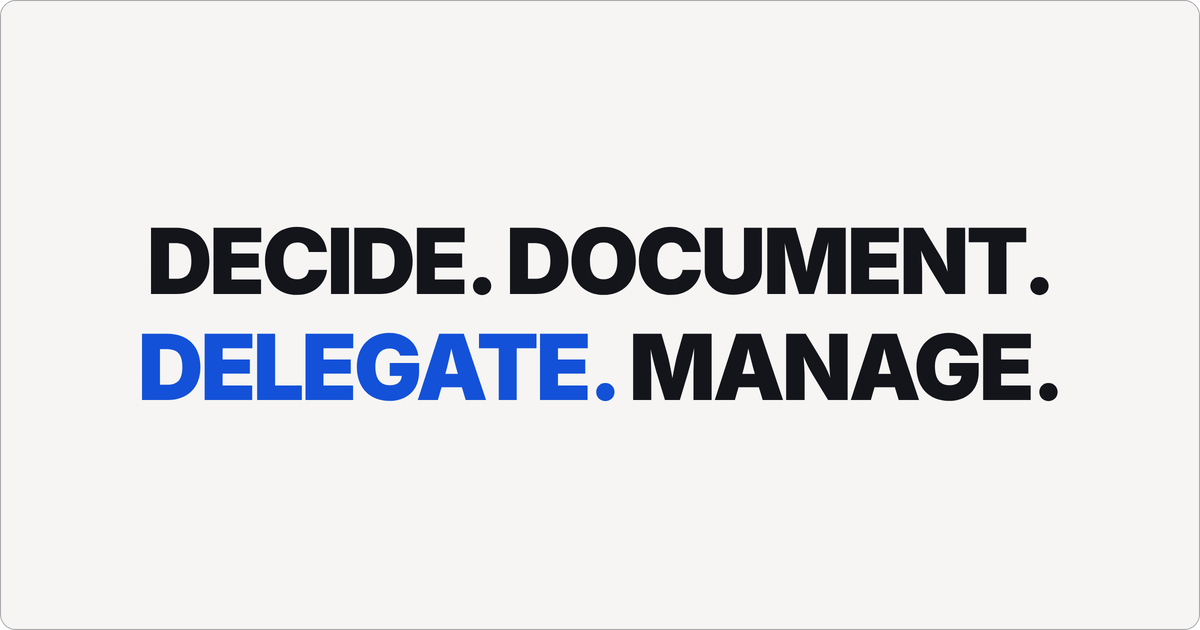
Put the business books side by side and something odd happens. They were written decades apart, for different readers, about different destinations, and they all prescribe the same four things in the same order. The vocabulary changes. The moves do not. We call them the Four Moves, and this is the post where I lay them out, name what each book calls them, and say plainly which one we are here for.
One process, many vocabularies
Gerber wrote for the person who opened a shop and discovered they had bought a job. Ferriss wrote for someone who wanted a lifestyle income. Netzley wrote for the owner stuck at six figures. Warrillow wrote for the owner who wants to sell. Wickman and Harnish wrote for companies heading to mid-market. Different readers, different endings. But strip the branding off and the process underneath is one process. Here is the crosswalk.
| Move | What it means | What the books call it |
|---|---|---|
| Decide | Choose which loops to leave, and which to leave first. | Gerber's work on the business, not in it. Ferriss's 80/20. Jenyns's Critical Client Flow. Michalowicz's Queen Bee Role. |
| Document | Choose one way of doing the work, and write it down so something other than you can run it. | Netzley's Model ONE. Warrillow's one standardized offering. Gerber's Operations Manual. Carpenter's Working Procedures. Martell's Playbooks. Wickman's documented core processes. |
| Delegate | Hand the documented work to a delegate that follows the document. | Gerber's ordinary employees. Ferriss's virtual assistants. Netzley's and Martell's admin hire. Sullivan and Hardy's Who. |
| Manage | Run the business by report, and step back. | Gerber's quantification. Ferriss's management by absence. Wickman's Scorecard. Michalowicz's four-week vacation. |
If you have read any two of these books, you have already noticed the overlap. What I want to add is the reason it matters: because the process is shared, the place where it breaks is shared too. Every book breaks in the same spot.
The half of Document nobody explains
Before we get to the break, a word about Document, because the books explain half of it badly and it is the half I get asked about most. Writing the work down is the obvious part. Choosing what to write comes first. Most businesses do the same things several ways, depending on who is doing them and what mood the day is in. Quoting, onboarding, invoicing, follow-up: three people, three methods, and the owner's own improvised version on top. Before you can document a duty, you commit to one of those ways and make it the way.
You cannot document a business that does something different for every client, and you cannot delegate what is not documented. The choice is usually much smaller than owners expect. Pick the way that works best today. Write that one down.
Where every book stops
Decide and Document are hard, but owners do them. I have met plenty of owners who have a folder of procedures, a clear sense of the one thing they sell, and a clear-eyed decision to work on the business. Then they reach Delegate, and the book hands them a person. Gerber says hire ordinary employees and give them the manual. Ferriss says virtual assistants. Netzley and Martell say build a team, starting with admin. Sullivan and Hardy say find your Who.
For a company with five to seventy-five people, every one of those answers has the same problem. The recurring work that fills the owner's week is too small to hire for and too important to drop. A good operations hire costs a salary, benefits, turnover, and the hours you spend managing them, and the work they would be doing is a few hours a day of follow-ups, reconciliations, reminders, and reports. The economics do not close. So the folder goes stale, and the owner goes back to doing the work by hand.
The manuals were written for a reader who never arrived.
Eric Lovgren, Lovgren Consulting Group
None of this is the books' fault. When they were written, the delegate had to be a person, and at this size the person did not pencil out. The advice was right. The delegate was missing.
Delegate, filled
An AI Employee is the delegate the books assumed. It takes the documented work, runs each duty from a playbook you keep, the same way every time, and reports to you every week. It does not improvise. When something does not match the playbook, it stops on that item and says so. It costs a fraction of the hire, it takes on more duties and more volume without another hire, and it makes Manage real, because there is finally a report to read instead of work to do.
Decide is where our discovery starts: we walk your flow, find the duties with a calendar attached, and you choose which loops to leave first. Document is the job description and the playbook, written in English, which you keep. Delegate is the AI Employee. Manage is the weekly run report and the quarterly review, which we handle on your behalf. The AI Employee is part of every move, and it is not the point. The point is the business you want and the week you get back.
We are the first client. We stalled at Delegate the same way, automated as far as conventional technology allowed, and still ran a sixty-hour week until AI arrived and we handed our own duties to an AI Employee. The full story, and the books behind the Four Moves, are on the About page. What the delegate actually does, duty by duty, is in How an AI Employee Duty Gets Written, Delegated, and Managed.
Nothing here replaces your operating system. The Four Moves are what those methods share with every other book in the genre, and the AI Employee is how the Process component finally gets Followed By All. We complement those methods and are not affiliated with any of them.
Which move are you on?
Thirty minutes, no preparation. We'll talk about your business and what you want from it. By the end you'll know whether it's a fit, and how soon your business could be running without you in every loop. Ready to make your first move?
No Pitch. Just Possibilities.